

Recent Posts




Where Luxury Watches Belong: America's Top 5 Markets by the WatchEQ Retail Index
 For brands and retailers in the high-end watch space, the location question is harder than it looks. Median income tells you something, but not enough — affluence alone doesn't predict whether a city actually moves $30,000 chronographs across the counter. Density matters. Demographics matter. So does the gravitational pull of nearby retail.
The WatchEQ Retail Index (WRI) is our answer to that question, built with data instead of intuition. It scores U.S. cities and zip codes on how well they support a luxury watch retail presence, combining three families of signal into a single index. You can explore the full methodology on the WatchEQ Score page.
What the WRI Measures
The WRI is a composite 0–100 score built from three components.
Wealth concentration. Drawn from the U.S. Census American Community Survey (ACS), with a focus on the density of households whose income and net worth profile is consistent with primary luxury watch buyers — not headline median income, which gets distorted in tourist-heavy or transient metros. We weight investable wealth and professional-class earner density more heavily than broad affluence.
Retail context. Pulled from our proprietary retailer database. We look at the presence and mix of authorized dealers, brand boutiques, and independent specialists within and adjacent to each market. A market with no nearby competition often signals an unserved opportunity; a market with dense, healthy competition signals a proven commercial engine. The WRI rewards both — what it penalizes is mismatch between demand and access.
Foot traffic and visitation proxies. Signals that capture how often qualified buyers are actually present — daytime versus residential population swings, corporate density, transit corridors, and the strength of adjacent luxury retail.
The three components are normalized and weighted into the final score. Higher means a stronger luxury watch market by both current performance and underlying fundamentals.
A note on what the WRI is not: it isn't a "best places to live" list, and it isn't a popularity contest. Plenty of wealthy zip codes don't crack the top 50 because their wealth profile doesn't match the luxury watch buyer specifically. High net worth that skews older and more conservative often spends differently than high net worth concentrated in finance, law, biotech, and entrepreneurship.
The Top 5
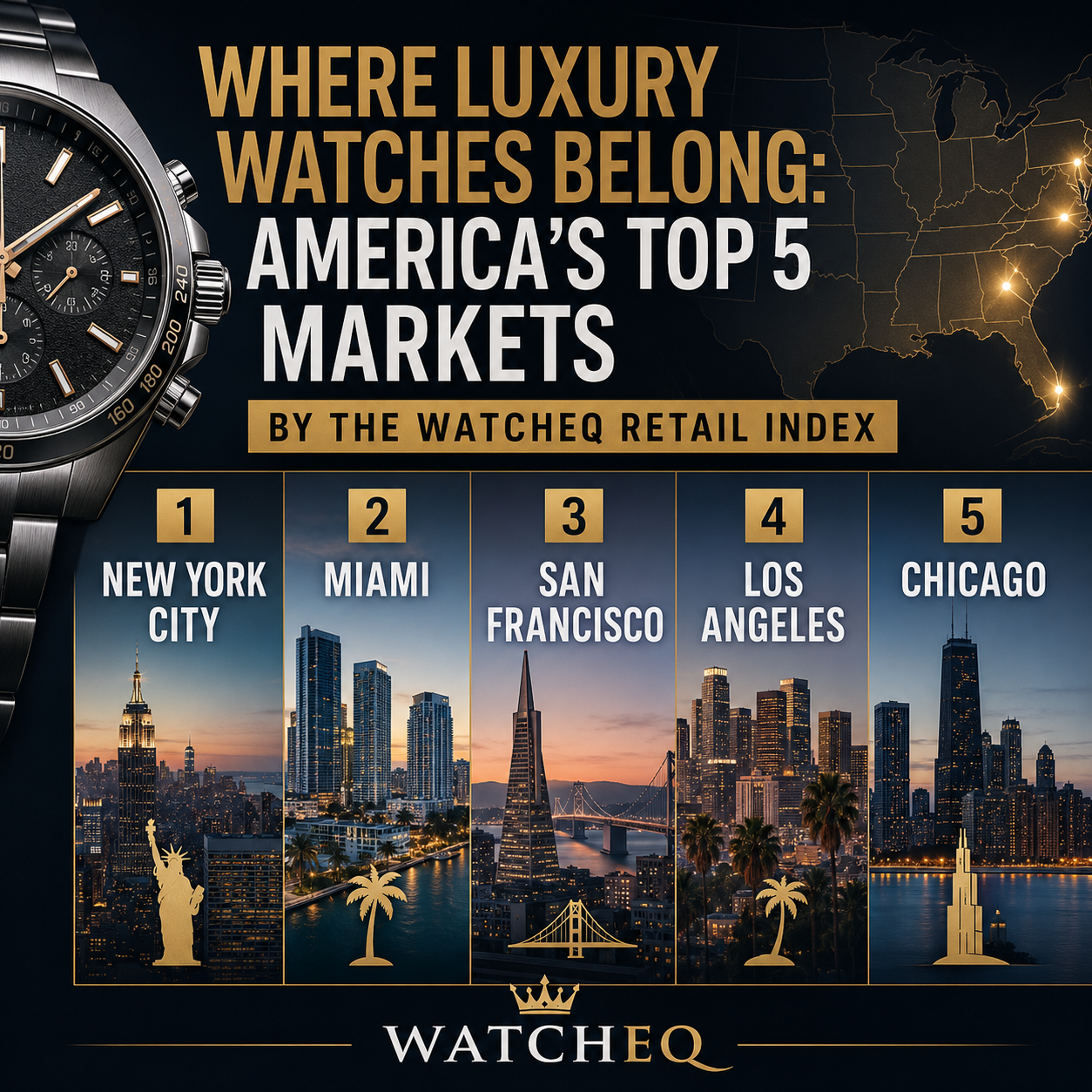
1. Manhattan, NY
Manhattan is the deepest and most diverse luxury watch market in North America. The Madison and Fifth Avenue corridors alone host more brand boutiques per linear mile than any other U.S. retail strip, and the borough's combination of resident wealth, corporate daytime population, and international visitor flow drives sustained demand across every price band.
In our model, Manhattan scores especially highly on retail context and foot traffic. Interestingly, the wealth signal isn't the strongest in the country — several suburbs concentrate household wealth more tightly per square mile — but the visitation and commercial density signals overwhelm every other U.S. market. The story here isn't opportunity in the green-field sense. It's sustained dominance.
2. Cambridge, MA
Cambridge punches above its size class for a single reason: the Kendall Square biotech corridor and the Harvard/MIT academic ecosystem produce a buyer profile the watch industry rarely studies but should. Late thirties to mid-fifties, technically educated, often the first generation in their family with serious disposable income, frequently with international ties.
Watch ownership in this demographic skews toward independents — F.P. Journe, MB&F, H. Moser — and toward purchase moments tied to IPOs, tenure, grants, and exits. Cambridge's WRI score reflects very high wealth density combined with surprisingly thin local retail. Much of the buyer flow currently leaves the city, heading to Boston's Newbury Street or to out-of-market boutiques. That gap is what the index is built to surface.
3. McLean, VA
McLean and its surrounding zip codes — Great Falls, parts of Vienna — are consistently among the highest-income areas in the United States. The wealth profile is defense, government contracting, and senior federal and lobbying professionals. Tysons Corner Center, immediately adjacent, has steadily grown its luxury watch footprint over the past decade.
The buying culture here is quieter than Manhattan — less brand-flashy, more attuned to dress watches and understated complications — but the per-capita spend is competitive with any market in the country. The WRI flags continued retail room, particularly for independents and for brands that have historically anchored in Manhattan and Beverly Hills first.
4. Newton, MA
Newton represents the multi-generational professional-class wealth pattern that the WRI is specifically built to detect. Median household incomes among the highest in Massachusetts, a strong concentration of medical, legal, and academic professionals, and a buying culture that values long-hold ownership over flip economics.
Newton's WRI score is, to a meaningful degree, an opportunity signal. There is no luxury watch retail of consequence inside the city itself. Qualified buyers either drive into Boston or transact through trusted out-of-state dealers and brand boutiques during travel. For a brand or independent retailer evaluating the Boston metro beyond Newbury Street, Newton is the highest-signal underserved market we've identified.
5. Bethesda, MD
Bethesda completes the pair of D.C.-orbit affluent suburbs in the top five, alongside McLean. Wealth here is anchored by the NIH and biotech corridor and the senior federal professional class. Bethesda Row already supports a steady luxury retail presence, and the WRI traffic signal reflects sustained daytime professional foot traffic — not just residential affluence.
The market profile mirrors McLean's in overall strength but tilts somewhat toward sport and lifestyle watches. We attribute this to a younger biotech-skewing buyer mix, which shows up clearly in the demographic component of the index.
What the Top 5 Tells Us
Four of the top five sit in the Northeast Corridor. Three are dense suburbs of major government and academic centers — McLean, Newton, Bethesda — rather than urban cores themselves. This is consistent with the broader WRI dataset: the strongest U.S. luxury watch markets in 2026 are not necessarily the biggest cities. They are concentrated pockets of professional-class wealth — finance, law, biotech, academia, defense — where multi-generational discretionary income meets a culture of object-as-marker.
It is also worth noting who is not in the top five. Beverly Hills, Aspen, Palm Beach, and Greenwich (CT) all post strong WRI scores, but the five above edge them out on either wealth density at scale (Beverly Hills' wealth disperses across surrounding LA retail) or sustained year-round buyer presence (Aspen and Palm Beach skew seasonal). Miami's Brickell and Bal Harbour, often cited as the next great American watch markets, sit just outside this list — strong on traffic and growing fast on wealth, but still maturing on the retail mix the index measures.
Why We Built This
The watch industry talks about its customer in averages and aggregates, and the reality on the ground is far more local than that. A great watch is bought in a moment — a promotion, a milestone, a gift to mark something that will be remembered. The geography of where those moments happen is not random. It is concentrated, it is patterned, and until now it has not been measured at the resolution the industry actually needs.
The WRI is our way of mapping it. To explore the full scoring methodology and see how your market ranks, visit the WatchEQ Score page.