

Recent Posts

The Most Serious Watch in the World Just Decided to Laugh
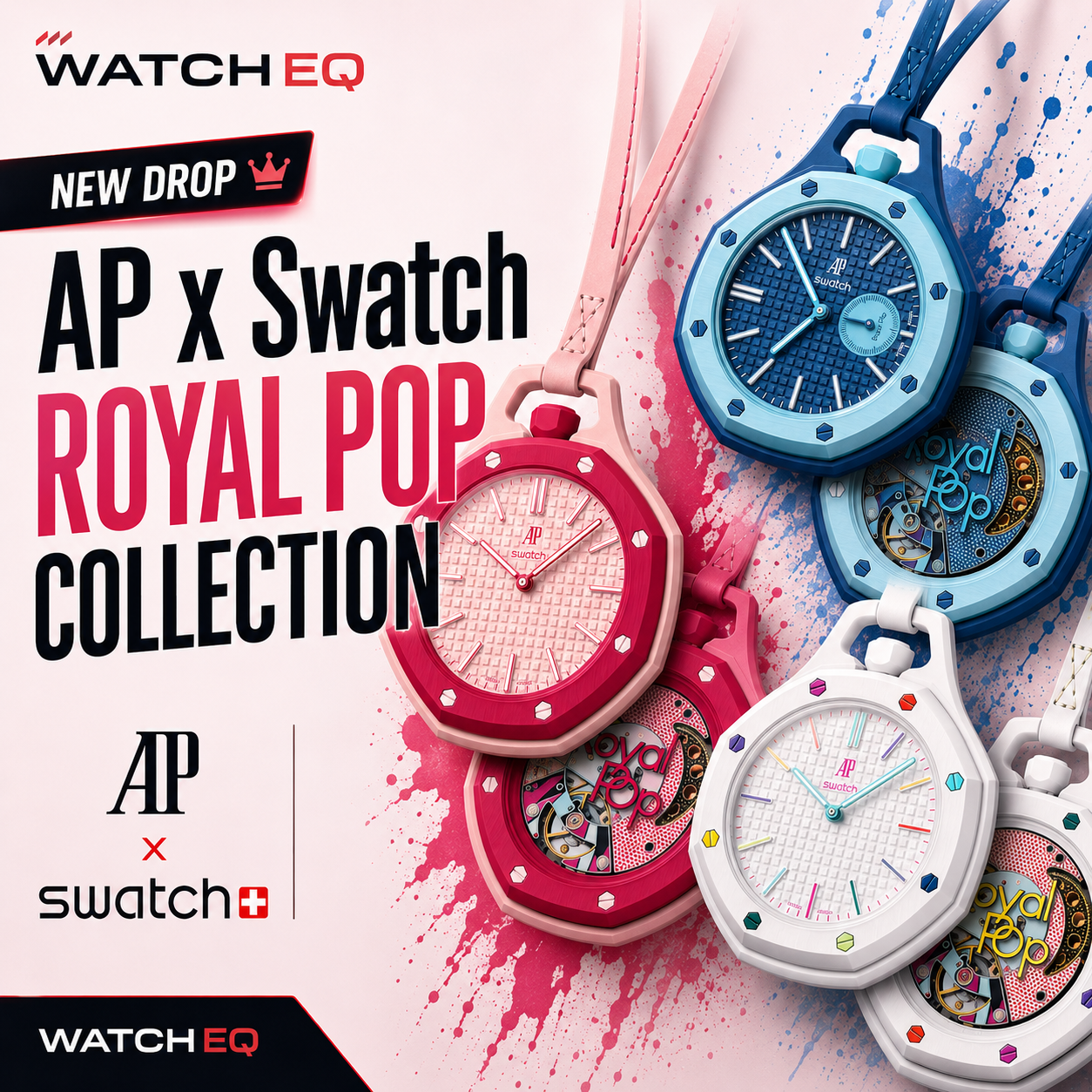
The Emotional Quotient — a WatchEQ read. The AP × Swatch Royal Pop isn't really about a $400 pocket watch. It's about what happens when the highest of high horology finally gives you permission to feel something other than gravity.
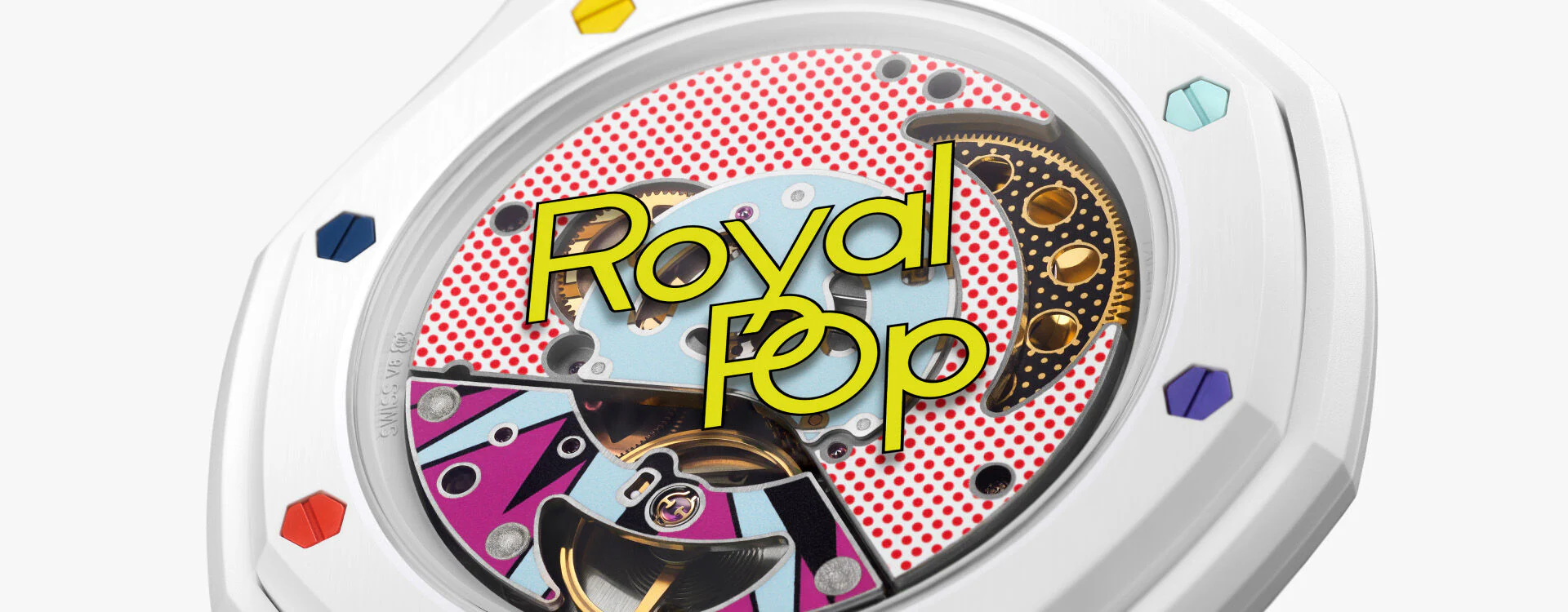
The case back of a Royal Pop. The Pop Art motif is digitally UV-printed across the movement bridges — and yes, those are real Lichtenstein dots. Image: Swatch.
At a Swatch boutique in Topanga this morning, hundreds of people were standing in a line that started forming five days ago. Folding chairs. Sleeping bags. A few people who clearly took the week off work.
They are not waiting for a watch. They are waiting for permission.
The watch, briefly
Audemars Piguet and Swatch have just dropped the Royal Pop — a collection of eight Bioceramic pocket watches that wear the Royal Oak's most sacred design codes (the octagonal bezel, the eight hexagonal screws, the Petite Tapisserie dial) in candy-painted Pop Art colors and a price tag of $400 to $420. They run on a brand-new hand-wound version of Swatch's SISTEM51 movement with a 90-hour power reserve, and they pop on and off a color-matched calfskin lanyard so you can clip one to a backpack, a belt loop, or, if you really want to, your wrist.
Eight colorways — each named for the word "eight" in a different language: Otto Rosso, Huit Blanc, Green Eight, Blaue Acht, Ocho Negro, Orenji Hachi, OTG Roz, and Làn Ba. The full lineup is on swatch.com.
That's the surface read. Spec sheet, queue length, $16,000 resale prices on the secondary market within hours of launch. You can find all of that on a dozen other sites by lunchtime today.
What I want to talk about is what this watch is actually doing — and why I think it matters more than any other release of 2026.
The EQ angle
At WatchEQ we obsess over a single question: What do people actually feel when they buy a watch? Not what they say at dinner parties — what they feel at 2am when they unbox it, what they feel three years in, what makes them keep it on their dresser instead of in a safe.
The luxury watch industry has spent the last fifteen years optimizing for exactly one emotion: seriousness. Gravitas. Heritage. Legacy. Worth. The Royal Oak in particular has become the most overdetermined object in horology — a watch where every owner secretly wonders if they're cool enough for it.
Then a Swatch Group CEO and an AP CEO got in a room and asked a different question:
What if the most serious watch in the world stopped being so serious for a minute?
That's the Royal Pop. Not a downmarket extension. Not a youth play. A permission slip.
The emotional grid
Here's a way to see what just shifted. Most luxury watches live in one quadrant of an emotional map — the top right, where seriousness meets exclusivity. That's where the Royal Oak has lived since 1972.
The Royal Pop doesn't move down the price axis. It moves across the emotional axis. It's the first time a Royal Oak silhouette has landed in the "joy" half of the grid — and the first time a Swatch has landed in the "icon" half:
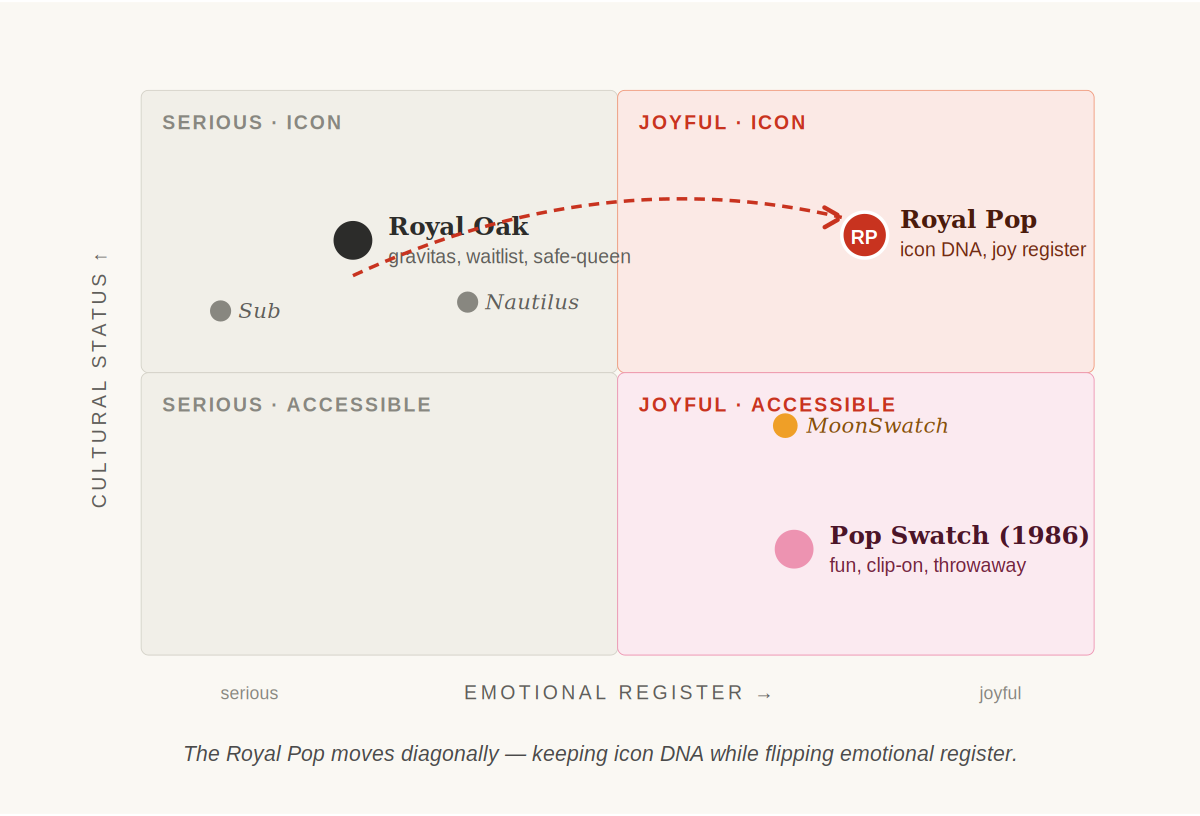
Figure 1 — The Luxury Watch Emotional Grid. The Royal Pop moves diagonally, keeping icon DNA while flipping emotional register.
Why this is the trick
Most collaborations slide along a single axis. A cheaper Rolex homage moves left on price. A Tudor moves left on heritage. The MoonSwatch moved left on both — and it worked, but it stayed in the "fun" quadrant where Swatch already lived.
The Royal Pop is the first collaboration I can remember that moves a serious icon diagonally — keeping its design DNA (the bezel, the screws, the tapisserie, the proportions) while flipping its emotional register from gravitas to glee. That's a much harder trick. And it explains the queues better than scarcity does.
The pocket watch detail nobody is talking about
Stop and notice this: it's a pocket watch.
Not a wristwatch. Not a chunky bracelet piece. A pocket watch on a calfskin lanyard with three length options, designed to clip to a bag, hang from your neck, sit on a desk, or pop into a back pocket.
This is not a coincidence. A wristwatch is read every time you check the time — it's a continuous statement of who you are. A pocket watch is a thing you take out, look at, share, and put away. It's an event, not an identity.
By choosing pocket watch as the form factor, AP did something subtle: they gave Royal Oak codes to people without forcing them to wear a Royal Oak every day. If you're a Royal Oak owner, this isn't competing with your safe queen — it's a desk toy that nods at it. If you're not a Royal Oak owner and never will be, this isn't a wannabe — it's the joke version, and the joke is consensual.
What AP gets out of it
Three things, in order of how much I think they actually matter:
1. The Royal Oak gets its sense of humor back. Genta's original 1972 design was a provocation — a steel sports watch priced like solid gold. It became holy. The Royal Pop reminds people the design was once supposed to be punk.
2. A generation gets baptized. The kid who buys an Orenji Hachi at 22 because it's fun is the same person who orders a 16202 at 42 because they remember. AP says 100% of their proceeds go to preserving watchmaking craft and developing the next generation of horological talent — but the brand pipeline they're seeding is the real return.
3. Permission gets redistributed. Right now, every Royal Oak owner in the world is slightly relieved. The watch they own just got cooler by association with something playful, and they didn't have to do anything for it.
The math, for the spec-curious
| Models | 8 (6 Lépine two-hand, 2 Savonnette small-seconds) |
| Case | 40mm Bioceramic; 44.2 × 53.2mm with clip; 8.4mm thick |
| Crystal | Acrylic (top); sapphire (case back) |
| Movement | New hand-wound SISTEM51, 15 active patents, no central screw |
| Power reserve | 90+ hours; visible mainspring barrel as a power-reserve cue (gray = wind it; gold = full) |
| Hairspring | Nivachron (anti-magnetic, co-developed by AP and Swatch in 2018) |
| Water resistance | 20m |
| Price (USD) | $400 (two-hand) / $420 (small seconds) |
| Availability | ~200 selected Swatch boutiques worldwide. One per person per day per store. |
Should you stand in the line?
Honest WatchEQ answer? Only if the feeling you'd get from owning one outweighs the feeling you'd get from skipping it.
This is a watch that will be everywhere on Instagram in 60 days, on eBay at 3-5x retail for at least six months, and quietly cherished by maybe a quarter of the people who bought one a decade from now. The two questions that matter are:
Do I actually love the design? Not the cultural moment. The object itself, on a Tuesday in March 2029 when nobody is talking about it anymore. The Royal Pop is a polarizing piece — that's a feature, not a bug, but you should know which side of the polarization you're on before you camp out.
Am I buying the joke or trying to outrun it? A Royal Pop bought because you genuinely think it's funny and brilliant is a piece that will age beautifully on your shelf. A Royal Pop bought to flip or to signal that you're "in the know" will feel hollow by Christmas. The collectors who do well with this watch will be the ones who would have bought it at full retail in a year with no hype.
If the Royal Pop is the most serious watch in the world finally laughing, the WatchEQ question is the one you should ask of any watch you buy: what does owning this make me feel — and is that a feeling I actually want? For some readers, the answer this week is "yes, joy." That's a perfectly good reason to stand in a line.
Sources: Swatch.com Royal Pop Collection, Audemars Piguet press materials, Revolution, SJX Watches, Teddy Baldassarre, Business of Fashion. WatchEQ has no affiliate relationship with Swatch or Audemars Piguet.